Showing posts with label 2008. Show all posts

Saturday, July 29, 2017

Fluids and Electrolytes with Clinical Applications 8th Edition

Fluids and Electrolytes with Clinical Applications: A Programmed Approach puts you in control of your learning experience. The self-paced, programmed approach makes learning and mastering difficult concepts simple and straightforward. The eighth edition provides a comprehensive survey of fluid, electrolyte, and acid-base imbalance concepts from the functions and movement of body fluids to intravenous solutions.
http://mmoity.com/1P8J

Saturday, May 28, 2016

Practical Aspects of Emergency Anesthesia (Step by Step)

    Preliminary Pages
    Chapter-01 Emergency Anesthesia in General
    Chapter-02 Shock    0.10 MB    11-22    Jaypee
    Chapter-03 Fluid, Electrolyte and Acid-base Disorders
    Chapter-04 Trauma
    Chapter-05 Burns
    Chapter-06 Anesthesia for Surgical Emergencies in Neonates, Infants and Children
    Chapter-07 Anesthesia for Obstetric Emergency
    Chapter-08 Anesthesia for Abdominal Emergency
    Chapter-09 Anesthesia for Emergency Neurosurgery
    Chapter-10 Emergency Anesthesia for Cardiothoracic Surgery
    Chapter-11 Emergency Anesthesia for Eye, Ear, Nose and Throat Surgery
    Chapter-12 Emergency Anesthesia and Common Pre-existing Medical Diseases
    Chapter-13 Miscellaneous
    Bibliography
    Index
http://adf.ly/1agSLz

Friday, February 26, 2016

Interventional Pain Management: A Practical Approach


- Interventional pain management is an important component to manage chronic intractable pain. Emphasizes upon performing correctly the right kind of interventional procedures from the moment of diagnosis to the point of relief from pain - Offers complete, concise, step-by-step guidance on the diagnosis of pain syndrome commonly encountered in clinical practice. Vivid illustrations depict the physical symptoms and anatomy of each pain site and diagnostic images demonstrate findings from MRI, CT and conventional radiography - This book features how to proceed and fully understand the nuances of each technique with illustrations showing relevant anatomy etc.
 http://adf.ly/1XWlEn

Saturday, July 11, 2015

Arterial Blood Gas Analysis: an easy learning guide


Blood gas analysis is one of the most frequently requested blood tests when caring for the critically ill patient, as it provides very valuable information about the respiratory and acid base status of the patient (Shoulders-Odom, 2000). However, many healthcare professionals find it difficult to get to grips with blood gas analysis. It often seems complex and daunting, but if you work your way through this book and carry out all the exercises, you will soon become confident and competent at analysing blood gases and will understand all the information that initially seemed so complicated. Blood gas analysis is a skill, which requires continuous practice, so once you have completed this workbook keep analysing blood gases as often as you can and discuss your findings with your mentor, until it becomes easy. With practice it will.

Wednesday, April 22, 2015

A Primer of Anesthesia


It is a comprehensive accessible guide to general and local anesthesia, with the substance and depth of a textbook. Covers clinical aspects of preoperative evaluation and administration of anesthesia for postoperative pain management of the critically ill surgical and medical patients on various life-support systems. Presents essential aspects, theoretical details with illustrations, photographs and line drawings. Provides clinical reference in cardiac anesthesia with complete information on drugs, monitoring cardio pulmonary bypass, circulatory support and anesthetic management of cardiac disorders. Section 1 THE PREOPERATIVE PERIOD, 1. Intravenous Anesthesic Agents and Opioids, 2. Inhalational Anesthetic Agents, 3. Physiology of Neuromuscular Blockade and Neuromuscular Pharmacology, 4. The Anesthesia Machine, 5. Preoperative Evaluation of patients, SECTION 2 THE INTRAOPERATIVE PERIOD, 6. Monitoring the Patient Under Anesthesia, 7. Vascular Cannulation, 8. Airway Management, 9. Neuraxial (Spinal and Epidural) Blockade, 10. Peripheral Nerve Blocks, 11. Fluid Therapy and Transfusion, SECTION 3. THE POSTOPERATIVE PERIOD, 12. Post-anesthesia Care, 13. Oxygen Therapy, 14. Infection and the Anesthesiologist, SECTION 4 CRITICAL CARE, 15. Care of the Patient in the ICU, 16. Cardiopulmonary Resuscitation.
http://adf.ly/1FdIgZ 

Tuesday, April 21, 2015

Peripheral Nerve Blocks: A Color Atlas


Thoroughly updated for its Third Edition, this best-selling full-color atlas is a step-by-step guide to performing more than 60 peripheral nerve blocks, including those used in children. For each nerve block, the book provides detailed information about indications, patient positioning, needle size, drug selection, volume for infusion rate, anatomic landmarks, approach, and technique and offers tips for maximizing effectiveness and minimizing complications. Full-color clinical photographs and line art demonstrate anatomic landmarks, patient positioning, and techniques. This edition offers new material on ultrasound guidance and continuous catheter techniques.

http://adf.ly/1FYp9q

Friday, December 12, 2014

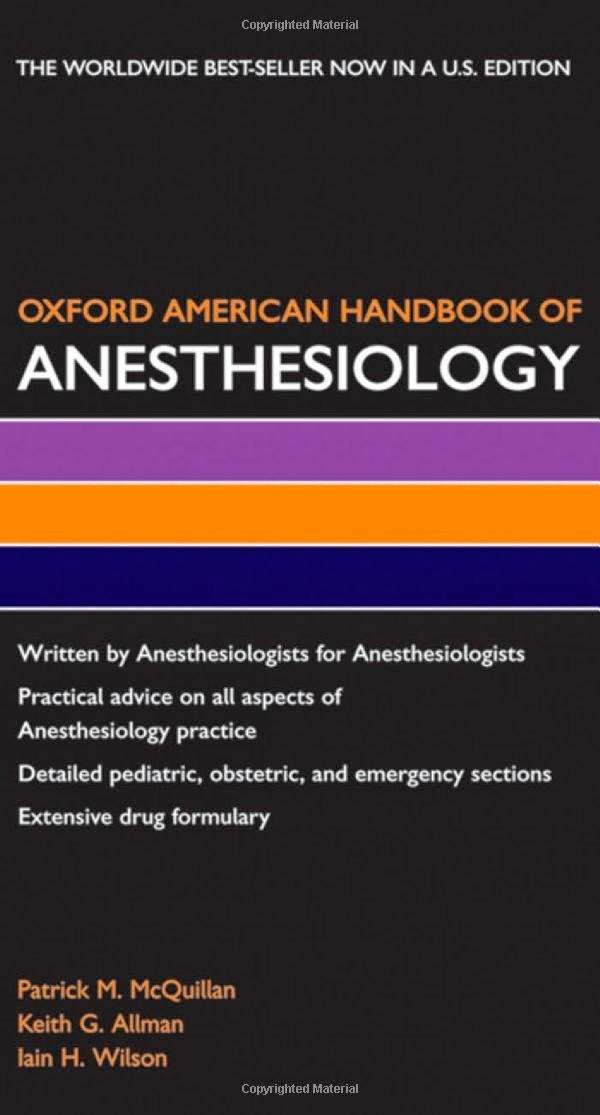
Oxford American Handbook of Anesthesiology


Written by leading American practitioners, the Oxford American Handbooks in Medicine each offer a pocket-sized overview of an entire specialty, featuring instant access to guidance on the conditions that are most likely to be encountered. Precise and prescriptive, the handbooks offer up-to-date advice on examination, investigations, common procedures, and in-patient care. These books will be invaluable resources for residents and students, as well as a useful reference for practitioners.

The Oxford American Handbook of Anesthesiology is a reliable manual that is geared for quick access, covering a full range of drug options and presenting guidelines for safe and effective patient care. At over 1100 pages in pocket format, it is comprehensive yet thin and light and also uses concise bulleted text, quick reference tabs, four-color presentation, and bookmark ribbons to help provide fast answers on the ward. This handbook is ideal for students and residents who want a succinct, comprehensive, and affordable volume in the proven format of the Oxford Handbook series.


Monday, December 1, 2014

Essentials of Cardiac Anesthesia: A Volume in Essentials of Anesthesia and Critical Care


Authored by the same stellar editors and contributors responsible for Kaplan's Cardiac Anesthesia, this title presents today's most essential clinical knowledge in cardiac anesthesia in a practical, user-friendly format. A manageable size and affordable price makes this an ideal purchase for every clinician who would like an economical yet dependable resource in cardiac anesthesia.

  • Provides the key cardiac anesthesia information you need to know by authorities you trust.
  • Uses a concise, user-friendly format that helps you locate the answers you need quickly.
  • Features key points boxes in each chapter to help you quickly access the most crucial information.
  • Includes annotated references that guide you to the most practical additional resources.
  • Features a portable size and clinical emphasis that facilitates and enhances bedside patient care.
  • Contains the authoritative guidance of larger reference books without the expense.

Wednesday, October 1, 2014

Core Topics in Cardiothoracic Critical Care


Most patients with critical cardiac or thoracic conditions will at some stage pass through the cardiothoracic critical care unit. Critical care presents more complex clinical data than any other area of medicine. Continuous monitoring makes diagnosis easy and further information can be easily obtained via a variety of diagnostic tools. Core Topics in Cardiothoracic Critical Care will guide clinicians from all disciplines in the management of cardiothoracic patients, demystifying the critical care unit and providing the key knowledge in a concise and accessible manner. The central section is a detailed discussion of the management of each physiologic system; additional sections cover admission, general considerations in cardiothoracic critical care, procedure-specific care, discharge and follow-up, structure and organization of the unit, and ethical and legal issues. All aspects of the overall care of the critically ill cardiothoracic patient are explained concisely and comprehensively by experts in the field.

Emergency sedation and pain management


Presented in an easily accessible, clinically oriented format, Emergency Sedation and Pain Management is a comprehensive medical text addressing emergency sedation and analgesia with specific emphasis on treatment of the emergency department patient. The text presents a clinical approach to the treatment of pain in emergency patients, including pediatric and adult populations. Analgesia, sedation, and anesthetic techniques are presented in an informative, authoritative, and concise format - written and edited by physicians with extensive research as well as clinical emergency medicine expertise. The chapters are richly supplemented with tables, photographs, and step-by-step illustrations.

Tuesday, September 30, 2014

Trauma Anesthesia


Trauma patients present unique challenges to anesthesiologists. Acute injuries require resource intensive care and are often complex cases especially when coupled with underlying, preexisting medical conditions. Anesthesiologists are involved with trauma patients beginning with airway and shock resuscitation, continuing with intraoperative care during surgery, and extending on to pain management and critical care post-operatively. This new reference focuses on a broad spectrum of traumatic injuries and the procedures anesthesiologists perform to adequately care for trauma patients perioperatively, surgically, and post-operatively. Special emphasis is given to the assessment and treatment of coexisting disease. Numerous tables and 300 illustrations showcasing various techniques of airway management, shock resuscitation, echocardiography and use of ultrasound for the performance of regional anesthesia in trauma, provide an invaluable reference for the anesthesiologist.

Thursday, September 25, 2014

Current Therapy in Pain


This unique resource focuses on the diagnosis and treatment of painful conditions-both acute and chronic-from a multi-disciplinary perspective. Joined by a team of nearly 200 international contributors representing a wide range of specialties, Dr. Smith presents the best management options within and across specialties. Succinct treatment and therapy guidelines enable you to quickly access clinically useful information, for both inpatient and outpatient pain management, while a 2-color format enhances readability and ease of use and highlights key concepts. And, as an Expert Consult title, it includes access to the complete contents online, fully searchable, plus links to Medline and PubMed abstracts-providing rapid, easy consultation from any computer!
  • Includes access to the complete text online, fully searchable, plus links to Medline and PubMed abstracts-providing quick and convenient reference from anyplace with an Internet connection.
  • Offers a cross-discipline approach to pain management for a comprehensive view of the best treatment options within and across specialties including internal medicine, gynecology, physical medicine and rehabilitation, orthopedics, and family medicine.
  • Provides succinct treatment and therapy guidelines, enabling you to locate useful information quickly.
  • Organizes guidance on acute and chronic therapies in a templated format, to facilitate consistent, quick-access consultation appropriate for inpatient or outpatient pain management.
  • Features a 2-color format that enhances readability and ease of use and highlights key concepts.

Thursday, August 7, 2014

Anesthesia and Analgesia in Dermatologic Surgery


With malpractice insurance premiums on the rise, and insurance rates for the practicing anesthesiologist at an all time high, it is important, now more than ever, to have a single source reference related to both anesthesia and analgesia and how they both relate to dermatologic surgery. This book provides comprehensive coverage on the therapeutic usage of anesthesia and analgesia during dermatologic surgical procedures, providing basic concepts, as well as step-by-step descriptions of the various techniques involved.
Written by an international group of contributors, Anesthesia and Analgesia in Dermatologic Surgery:
    is the first book of its kind to present both anesthesia and analgesia techniques in a single source volume
    covers the basic principles of regional and local anesthesia with respect to anatomy, local anesthetic agents, and techniques
    examines new eutectic mixtures that penetrate through the skin’s membrane, enabling doctors to use analgesia over anesthesia for a wide range of superficial surgical procedures, including the harvesting of split skin grafts, laser surgery, electrosurgery, epilation, and skin biopsy
    discusses the use of nerve blocks as safer alternatives to local anesthesia
    contains a full chapter dedicated to the pediatric patient, and the specific concerns when relating anesthesia to the pediatric patient

Monday, August 4, 2014

Manual of Emergency Airway Management


Prepared by the faculty of the National Emergency Airway Management Course, this manual is an expert, practical guide to emergency airway management in any adult or pediatric patient. It offers step-by-step instructions on techniques, drug administration, and prevention and management of complications and includes a complete section on difficult clinical scenarios. The book is packed with easy-to-follow algorithms and diagrams and helpful mnemonics. Each of the Third Edition's chapters includes improved full-color illustrations and updated evidence-based analyses of procedures. A new section geared to the prehospital setting presents current National Association of Emergency Medical Technicians guidelines, including alternative airway devices.

Tuesday, July 8, 2014

MCQs for the Primary FRCA


Designed for candidates sitting the primary FRCA examination, this book brings together exam questions from recent years and structures them into six practice papers. The format of 90 questions per paper echoes the exam itself. Following each paper a scoring chart and detailed explanations of answers are provided. The questions cover physiology, pharmacology, physics, clinical measurement and statistics as they appear in the primary FRCA. There are questions on all recently added exam topics, and those that now carry stronger emphasis and more weight such as resuscitation, sepsis and trauma. The latest drugs, equipment, monitoring techniques and safety procedures are referenced. Trainees will find this an invaluable tool for exam preparation, whether sitting the FRCA in the UK, through the London College external examiners in many Asian and African countries, or similar exams for anaesthetists in Australasia and North America.

Wednesday, April 9, 2014

Clinical Pain Management Second Edition: Chronic Pain


The second edition of Chronic Pain now covers a vast scientific and clinical arena, with the scientific background and therapeutic options much expanded. In common with the other titles comprising Clinical Pain Management, the volume gathers together the available evidence-based information in a reader-friendly format without unnecessary detail, and is divided into three parts.
The broad coverage under Part One encompasses basic science, including applied physiology, genetics and epidemiology, through societal aspects of chronic pain and disability, to patient assessment, diagnostic procedures and outcome measures.
Part Two considers the different therapies available, including pharmacological, psychological, behavioural, interventional and alternative.
In Part Three specific and non-specific pain syndromes and their management are described, including pain in neurological disease, in HIV and AIDS patients, and after surgery or spinal cord injury, regional pain in the head, face, neck, back, joints, chest, abdomen and pelvis, and issues related to pain in children, the elderly and in association with substance misuse.

Saturday, April 5, 2014

Comparative Pharmacology for Anaesthetist

This book has been designed for PG students of anaesthesiology so that they can remember the properties of various anaesthetic drugs. It includes comparative charts, line diagrams and points of clinical relevance for easy understanding of anaesthetic drugs. Contains 9 chapters namely, Neuromuscular Blocking Agents Neuromuscular Junction, Opioids, Volatile Anaesthetics, Intravenous Induction Agents, Inotropes, Anticholinergic Drugs, Anticholinesterases, Local Anaesthetics, Miscellaneous Drugs.

Sunday, March 30, 2014

Anesthesia for Cardiac Surgery

This comprehensive, state of the art overview of pediatric and adult cardiac anesthesia brings together all the latest developments in this rapidly developing field. This text is intended both as a reference and for daily use by practicing and prospective anesthesiologists.
Thoroughly updated for its third edition, Anesthesia for Cardiac Surgery fills the gap between encyclopaedic references and brief outlines, presenting just the right amount of information to guide trainees and practitioners who care for cardiac surgical patients.
This edition features:
 The introduction of Dr Zvara as co-editor
 A new chapter on Special Considerations
 Practical clinical information coupled with comprehensive descriptions of physiology
 Key facts and tables summarized for convenient access

Sunday, January 5, 2014

Manual of Anaesthesia


This completely updated practical reference is a comprehensive guide to the anaesthetic and preoperative management of patients during all procedures performed by general and subspecialists The book explains that each procedure needs to be evaluated before performing it whether for anaesthetic purpose or medication Explains the fundamentals of clinical anaesthesia by providing a point-wise discussion on each procedure so that students grasp the subject easily and thoroughly. Explanation of each procedure from the perspective of all concerned to make decisions before, during and after surgery.

Friday, December 27, 2013

CURRENT Diagnosis and Treatment Critical Care 3rd


CURRENT Diagnosis & Treatment: Critical Care delivers authoritative and clinically focused guidance in a concise, find-it-now format. Following the trusted LANGE approach, it includes a review of the etiology, relevant pathophysiology, and clinical symptoms as a prelude to diagnosis and treatment. Coverage includes everything from renal failure and surgical infections to coronary heart disease. There is a strong emphasis on evidence-based medicine throughout.
Features:
 Comprehensive overview of 39 key critical care topics, covering critical care basics, medical critical care, and the essentials of surgical critical care
 Valuable perspectives on the latest technologies, equipment, therapeutic strategies, and interventions
 Addresses common but difficult-to-diagnose critical care problems and delivers “approach to the patient” strategies
 NEW! Important treatment strategies for venous thromboembolism, acute respiratory distress syndrome, diabetic ketoacidosis, asthma, sepsis, and many more
 NEW! Current recommendations for deep vein thrombosis prophylaxis, transfusions, goal-directed therapy in sepsis, mechanical ventilation, use of pulmonary artery catheters, and glycemic control
 NEW! PMID numbers on all references for easy look-up