Showing posts with label Regional Anesthesia. Show all posts

Friday, October 20, 2017

Complications of Regional Anesthesia: Principles of Safe Practice in Local and Regional Anesthesia 3rd

Reflecting the rapid growth of pain medicine and of ultrasound as a tool, this Third Edition is more comprehensive and inclusive than previous editions and features additional pages, tables, diagrams, and color illustrations. In addition to the discipline of Anesthesiology, other specialists, who use local and regional anesthesia techniques, (surgeons, ophthalmologists, emergency medicine physicians and dentists), have also contributed to this edition of the book. Complications of Regional Anesthesia, with its newly added subtitle, Principles of Safe Practice in Local and Regional Anesthesia, stresses the relatively new emphasis and importance on safety and prevention and broadens the discussion to include the practice and administration of not just regional but also local anesthesia.
Each chapter has been thoroughly revised, brought up-to-date, and features full color images. Individual chapters cover complications associated with specific nerve blocks; IV and catheter methods; obstetric regional anesthesia; pediatric regional anesthesia; ophthalmic regional anesthesia; and treatment of acute and chronic pain.
http://skamason.com/7how 

Sunday, September 24, 2017

Cousins and Bridenbaugh’s Neural Blockade in Clinical Anesthesia and Pain Medicine

This comprehensive, authoritative text presents the scientific foundations and clinical practice of neural blockade in both regional anesthesia and the management of pain. The descriptions and illustrations of pain mechanisms are considered classic examples. The Fourth Edition has been refined for clarity and flows logically from principles and pharmacology, to techniques for each anatomic region, to applications. This edition has two new co-editors and several new chapters on topics including neurologic complications, neural blockade for surgery, treatment of pain in older people, and complications in pain medicine.
http://kimechanic.com/2JzA 

Saturday, August 5, 2017

Atlas of Neural Therapy With Local Anesthetics


Known to provide instant relief of pain, increased
motion, and return of function for a variety of problems unresolved by other
methods, neural therapy is widely used throughout Europe and is rapidly gaining
worldwide acceptance in the therapeutic armamentarium elsewhere. This new
edition of Dr. Mathias Dosch’s classic Atlas of Neural Therapy with Local
Anesthetics
covers the methodology, indications, and techniques for a proven therapy, which involves injecting procaine or lidocaine into specific nerve and tissue sites to restore proper bioelectrical function. With this striking visual guide at hand, even physicians without extensive prior experience in neural therapy will be able to implement the techniques successfully in their everyday practice.
http://dataurbia.com/pg6

Monday, July 10, 2017

Total Intravenous Anesthesia and Target Controlled Infusion

This is a comprehensive and authoritative presentation of total intravenous anesthesia (TIVA) and target controlled infusion (TCI). The editors’ international reputation has enabled them to recruit leading experts from around the world to write single-author chapters in their area of expertise. Total Intravenous Anesthesia and Target Controlled Infusions is the first multi-disciplinary, globally authored volume on the topic.  

Providing a single source of information on all aspects of TIVA and TCI, from pharmacologic modeling and the pharmacology of intravenous anesthetic drugs to practical considerations in the clinical setting and the requirements of special populations, Total Intravenous Anesthesia and Target Controlled Infusions examines the debate about the risks and advantages of TIVA, analyze outcome studies, and provides guidance on creating a curriculum to teach TIVA and TCI.

Thursday, May 4, 2017

LOCAL AND REGIONAL ANAESTHESIA IN THE EMERGENCY DEPARTMENT

This volume in the successful Made Easy series is aimed at all doctors working in accident and emergency departments to help remind them of the common nerve block techniques. These techniques can be difficult to master and require great precison. Each procedure is described in step-by-step detail along with accompanying colour illustrations.http://microify.com/yIp

Wednesday, February 8, 2017

The Anatomical Foundations of Regional Anesthesia and Acute Pain Medicine

Students and practitioners of regional anesthesia and acute pain medicine often ask how they can be consistently as successful with their blocks as the true experts are. Too often do scholars focus on learning techniques of RA and APM from experts, and then get lost in a myriad of bad results that include primary or secondary block failures. The answer to this question is that every discipline of medicine has a unique fundamental truth, and true understanding this fundamental truth is essential for success. If we truly understand that the fundamental truth of Critical Care Medicine, for example, is the management and maintenance of physiological barriers. Similarly, the fundamental truth of anesthesia is the management of physiological reflexes. The fundamental truth of regional anesthesia and acute pain medicine is, according to the timeless wisdom of Alon Winnie, the in depth knowledge and true understanding of anatomy. If we fully understand where nerves live (macroanatomy), we completely understand what the nerves live in - the membranes and barriers that surround them (microanatomy) and we know how to find these nerves (sono- and functional anatomy) we can use any technique to do any nerve block and we will be successful. With this fundamental understanding, we can now better appreciate, on an anatomical basis, why blocks sometimes fail; where the "sweet spot" of a nerve is and how to find it; why epidural blocks are segmental while subarachnoid blocks are not; why older patients are less prone to postdural puncture headache, and many more issues of regional anesthesia and pain medicine. The basic working philosophy and design of this textbook is that the reader can obtain a good practical working knowledge of the macro-, micro-, sono-, and functional anatomy required for regional anesthesia and acute pain medicine simply by viewing the figures and movies and reading the legends to the figures. If more in depth information is needed, the extensive text and reference list would adequately compliment this knowledge
http://adf.ly/1jVWmV 

Thursday, July 21, 2016

Ultrasound-Guided Regional Anesthesia and Pain Medicine


Get up-to-date on all of the techniques that are rapidly becoming today’s standard of care with Ultrasound-Guided Regional Anesthesia and Pain Medicine, 2nd Edition. With this extensively revised edition, you’ll see how the increased use of  ultrasound for diagnosis and treatment of chronic pain and other medical conditions can transform your patient care. Noted authorities discuss the techniques you need to know for upper and lower extremity blocks, truncal blocks, pain blocks, trauma and critical care, and more.

Key Features:
Quickly grasp the salient features of each block, including indications, relevant anatomy, the transducer type, needle, local anesthetic, technique, tips, and references for further study.Learn from global experts on topics such as recent ultrasound-guided musculoskeletal blocks and the uses of ultrasound in the treatment of shock and trauma.Get up to speed on new techniques, thanks to 48 new chapters covering transforaminal cervical injections, cervical facet injections, insertion of peripheral nerve stimulators using ultrasound guidance, genital femoral nerve injections, suprascapular nerve injection, ultrasound guidance to fill implanted pain reservoir, sacroiliac injections, and much more.Care for your young patients more effectively with a separate section devoted to pediatric regional anesthesia. See exactly how to perform the techniques with high-quality ultrasound images and depictions of relevant anatomy.Now with the print edition, enjoy the bundled interactive eBook edition, offering tablet, smartphone, or online access to:Videos of selected procedures.Complete content with enhanced navigation.Powerful search tools and smart navigation cross-links that pull results from content in the book, your notes, and even the web.Cross-linked pages, references, and more for easy navigation.Highlighting tool for easier reference of key content throughout the text.Ability to take and share notes with friends and colleagues.Quick reference tabbing to save your favorite content for future use.
http://adf.ly/1cUIkX 

Thursday, June 9, 2016

REGIONAL ANAESTHESIA A POCKET GUIDE


Description
Review
Overall, this is a most attractive, easy-to-read, practical handbook of regional anaesthesia... As an established practitioner of regional anaesthesia, I will refer to it frequently, and I may even be encouraged to attempt less commonly used techniques within my own practice, with this for bedside reference... A welcome addition to the regional anaesthesia literature! British Journal of Anaesthesia Z September 2014
Product Description
Regional Anaesthesia: A Pocket Guide is an essential companion to the practice of regional anaesthesia for consultants and trainees in the specialty. Filled with practical advice and carefully designed for ease of use, this book is the helpful aid to practice that anaesthetists have been waiting for. 
The book covers all the major blocks by anatomical region, from the head and upper extremities, to the lower extremities and para-axial region. The technique for each procedure is prefaced by information on its difficulty, indications, contraindications, and potential side-effects. Every procedure is also accompanied by a range of high-quality clinical photographs and anatomical drawings that demonstrate the importance of applying anatomical knowledge in practical anaesthetic procedures. 

Regional anaesthesia is a fast-moving specialty, and this book takes into account recent advances in ultrasound-guided techniques with a strong focus on real-time observation of needle placement. Landmark-placed blocks have are also covered for clinicians without access to ultrasound technology. 
Regional Anaesthesia: A Pocket Guide is a unique compilation of anaesthetic techniques that offers support and guidance for any trainee or specialist in their every day practice.

Wednesday, June 1, 2016

Pediatric Atlas of Ultrasound- and Nerve Stimulation-Guided Regional Anesthesia


This is the first comprehensive text-atlas that shows how to use ultrasound technology and nerve stimulation techniques to guide regional blockade in children. Clinical chapters follow a sequential, highly illustrated format that provides step-by-step guidance and include cases, clinical pearls, and troubleshooting tips. Nearly 400 figures, consisting of ultrasound images, MRI images, and schematics, have been assembled to maximize understanding of pediatric neuroanatomy and its relationship to surrounding anatomical structures. To help the novice user, the book features side-by-side presentation of unlabeled and labeled ultrasound images.
Pediatric Atlas of Ultrasound- and Nerve Stimulation-Guided Regional Anesthesia focuses on common approaches, supplemented in clinical pearls and notes by alternative approaches, and emphasizes dynamic and systematic scanning techniques. It is intended for pediatric anesthesiologists who wish to incorporate regional blockade into their repertoire and designed as a refresher and resource for all regional anesthesiologists seeking to refine their skills.
Unique Selling Points:
  • Internationally renowned experts
  • Presents two technologies proven to improve block success when used together
  • Superb coverage of pediatric anatomy in relation to regional anesthesia
  • Equipment, set-up, pain assessment, local anesthetic pharmacology, and patient safety considerations for child patients
http://adf.ly/1amSUs

Friday, February 19, 2016

Atlas of peripheral regional anesthesia : anatomy and techniques


The Atlas of Peripheral Regional Anesthesia: Anatomy and Techniques, Third Edition is a comprehensively revised reference that provides readers with essential anatomical knowledge along with step-by-step instructions on how to perform even the most complex regional anesthesia procedures with particular focus on ultrasound-guided techniques. This new edition is enhanced with over 700 full-color illustrations as well as an extensive selection of videos on Thieme's MediaCenter.

Key Features of the Third Edition:
More than 250 new and updated figures, anatomical illustrations, and cadaver dissection photos which demonstrate the techniquesNew section describing the general aspects of ultrasound imaging in performing peripheral nerve blocksNew section on pediatric regional anesthesiaOnline access to more than 250 video films of the techniquesThis new edition is an invaluable resource for all anesthesiologists, orthopedists, and pain management physicians involved in the administration of regional anesthesia.
http://adf.ly/1X9QRj 

Monday, March 23, 2015

Textbook of Regional Anesthesia


This authoritative and comprehensive reference by an international team of distinguished experts, explores all aspects of the field—from the basic science of regional anesthesia to its implementation in clinical practice. Up-to-date information is organized into a consistent, quick-access format that is highlighted by over 300 outstanding illustrations. No other book has as much information on setting up an Acute Pain Service, outcomes and evidence based medicine, as well as coverage on advanced interventional techniques.

Atlas of Functional Anatomy for Regional Anesthesia and Pain Medicine: Human Structure, Ultrastructure and 3D Reconstruction Images


This is the first atlas to depict in high-resolution images the fine structure of the spinal canal, the nervous plexuses, and the peripheral nerves in relation to clinical practice. The Atlas of Functional Anatomy for Regional Anesthesia and Pain Medicine contains more than 1500 images of unsurpassed quality, most of which have never been published, including scanning electron microscopy images of neuronal ultrastructures, macroscopic sectional anatomy, and three-dimensional images reconstructed from patient imaging studies. Each chapter begins with a short introduction on the covered subject but then allows the images to embody the rest of the work; detailed text accompanies figures to guide readers through anatomy, providing evidence-based, clinically relevant information. Beyond clinically relevant anatomy, the book features regional anesthesia equipment (needles, catheters, surgical gloves) and overview of some cutting edge research instruments (e.g. scanning electron microscopy and transmission electron microscopy).

Tuesday, December 2, 2014

Regional Anaesthesia, Stimulation, and Ultrasound Techniques (Oxford Specialist Handbooks in Anaesthesia), 1E


Regional anaesthesia is used across specialties within anaesthesia, and is a rapidly growing sub-specialty. This new handbook covers both traditional and ultrasound guided techniques, concentrating on the differences between them. Offering readers a comprehensive overview for clinical practice, it includes paediatric and acute pain applications. Each topic covers anatomy, contraindications, landmark/US settings, technique, complications, and clinical notes. Discrete sections on pharmacology, principles, and training further the book's use for teaching purposes.

It will appeal to both trainees and consultants in regional anaesthesia, as well as anaesthetic nurses and anaesthetic practitioners. Presented in the Oxford Specialist Handbook series, it offers practical advice as well as background information in a convenient pocket-sized title.

Friday, July 25, 2014

Multiple Choice Questions in Regional Anaesthesia


Interest in regional anaesthesia has been flourishing for a number of reasons, including in particular the feasibility of ultrasound-guided peripheral nerve blocks. This trend is reflected in the growing popularity of fellowships in regional anaesthesia. The syllabus for such fellowship examinations is vast, and the current book aims to provide suitable guidance by presenting typical multiple choice questions with accompanying answers, in detail when necessary. The entire syllabus is covered in four sections that address basic principles and equipment, peripheral nerve blocks, central neuraxial blocks, and regional anaesthesia and acute pain. This book will be especially useful for those preparing for European Society of Regional Anaesthesia diploma examinations or for the regional anaesthesia component of FRCA examinations. It is also highly relevant to equivalent U.S. and Canadian examinations and will be helpful to all who require a self-assessment tool in the subject.

Monday, July 14, 2014

Essentials of Regional Anesthesia


This is a compact, single-source guide to regional anesthesia.  Chapters are authored by regional anesthesia fellowship directors and fellows to insure maximum practicality and up-to-date coverage.

Essentials of Regional Anesthesia covers all anatomical regions as well as the unique considerations in patients with chronic pain, obstetric patients, pediatric patients, and patients treated in the outpatient setting.   A common chapter format makes it easy to find information quickly, and extensive illustrations enhance the text.  
Stay current with Essentials of Regional Anesthesia, and stay ahead with these helpful features:
• Ultrasound incorporated into each block
• Extremely practical focus
• More than 400 Q & As to test knowledge
• Authored by regional anesthesia fellowship directors and fellows
• Clinical pearls and guidance on complications
• Concise, clinically oriented review of relevant basic science
• Common chapter format for ease of use
• Well illustrated with 350 figures, nearly 200 in color

Sunday, June 8, 2014

Complications in Regional Anesthesia and Pain Medicine, 1e


This single-source reference addresses complications related to the practice of regional anesthesia and pain medicine. Chapters are written by a world authority on each specific complication and are evidence-based from an extensive literature search. Each chapter is constructed to follow a defined approach to the problem to ensure inclusiveness of evidence, clarity, and consistency.
Provides a definition for each complication
Details the risk factors so you can make informed decisions on treatment
Includes details on treatment and rehabilitation providing you with a complete solution to any complication you encounter
Advises you on when to seek further consultation

Tuesday, December 3, 2013

Ultrasound-Guided Regional Anesthesia: A Practical Approach to Peripheral Nerve Blocks and Perineural Catheters


Regional anesthesia is a fast-growing field, fuelled by the application of ultrasound technology over the last decade. This book is a technique-oriented guide, which introduces the use of ultrasound technology with practical instruction in the placement of peripheral nerve blocks and continuous perineural catheters. Each procedure is summarized for quick, easy reference, and supplemented by ultrasound images, color photos, and detailed illustrations. Helpful hints and instructions are provided to further optimize block success. Chapters are organized into four sections, focusing on introductory concepts, upper extremity peripheral nerve blocks, lower extremity peripheral nerve blocks and continuous perineural catheters. Written by instructors from a major academic medical center who work in a fast-paced ambulatory setting, this is a key text for residents, fellows and staff physicians who wish to incorporate the use of ultrasound into the scope of their anesthetic practice.
http://adf.ly/1CvW7S

Saturday, November 9, 2013

Atlas of Regional Anesthesia

David L. Brown MD (Author)

Atlas of Regional Anesthesia, by Dr. David L. Brown, has been the go-to reference for many years, helping clinicians master a myriad of nerve block techniques in all areas of the body. This meticulously updated new edition brings you state-of-the-art coverage and streaming online videos of ultrasound-guided techniques, as well as new coverage of the latest procedures. Hundreds of high-quality full-color illustrations of anatomy and conventional and ultrasound-guided techniques provide superb visual guidance. You'll also have easy access to the complete contents online, fully searchable, at expertconsult.com.
 Obtain superior visual guidance thanks to hundreds of high-quality illustrations of cross-sectional, gross, and surface anatomy paired with outstanding illustrations of conventional and ultrasound-guided techniques.
 Master the ultrasound-guided approach through 12 online videos demonstrating correct anatomic needle placement.
 Access the complete contents online and download all of the illustrations at expertconsult.com.
 Learn the latest techniques with a new chapter on transversus abdominis block and updated coverage of nerve stimulation techniques, implantable drug delivery systems, spinal cord stimulation, and more.
A must-have atlas covering all techniques in regional anesthesia with high-quality images, a new online companion and added illustrative and video coverage of ultrasound-guided techniques

Tuesday, October 8, 2013

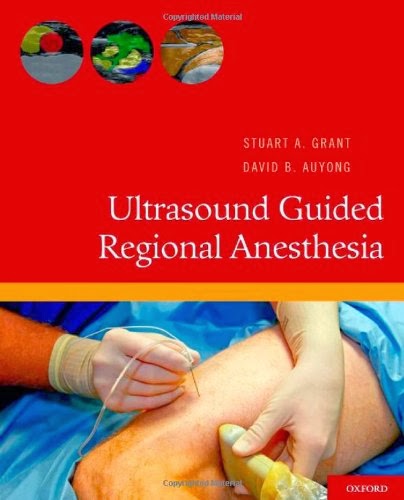
Ultrasound Guided Regional Anesthesia


Stuart A. Grant (Author), David B. Auyong (Author)

Ultrasound technology is enabling anesthesiologists to perform regional anesthetic procedures with greater confidence in accuracy and precision. With improvements in visualizing neural anatomy and needle movement, ultrasound guidance improves patient safety and operating room efficiency. This book offers a detailed, stepwise approach to this technique, identifying pearls and pitfalls to ensure success. Chapters are organized into four sections. The first section provides the basic principles behind ultrasound guided regional anesthesia, setting a strong context for the rest of the book. The last three cover the nerve blocks: upper limb, lower limb, and trunk and spine. Each nerve block is comprehensively explained, divided up by introduction, anatomy, clinical applications, technique, alternate techniques, complications, and pearls. This book provides authoritative, in-depth coverage of ultrasound guided regional anesthesia for the anesthesiologist beginning to use ultrasound and makes a great reference for the more seasoned.

Here

Wednesday, June 1, 2011

Complications of Regional Anesthesia


Finucane's book should join the required reading list for residents on a regional anesthesia rotation... The beauty of Finucane's book is that although it addresses the contemporary profile of complications, after reading it, I am now even more enthusiastic about regional anesthesia
This updated and expanded 2nd Edition offers practical advice on the prevention and management of complications associated with regional anesthesia and nerve blocks. Besides comprehensive coverage .of potential pitfalls for the practicing anesthesiologist, the book adds new material exploring outcomes of regional and general anesthesia. The book offers full chapters on specific anatomic sites, including spinal, epidural, ophthalmic, and brachial plexus anesthesia. Other chapters address specialties of practice: obstetrics, pediatrics, and cancer. The book includes clinical studies and closed case analyses, and practical advice on prevention of complications. A concluding section offers detailed, real-world oriented practice guidelines for Regional Anesthesia.


Book Details:
Author:Brendan T. Finucane
Publisher:Springer; 2nd edition (April 2, 2007)
Pages:526
Size:5,495 MB
Format:pdf


Download
Password:DrWael