Sunday, October 13, 2013

Cottrell and Young's Neuroanesthesia 5e

 James E. Cottrell MD (Author), William L. Young (Author)


Cottrell's Neuroanesthesia 5th Edition, edited by James E. Cottrell, MD, FRCA and William L. Young, MD, delivers the complete and authoritative guidance you need to ensure optimal perioperative safety for neurosurgical patients. Integrating current scientific principles with the newest clinical applications, it not only explains what to do under any set of circumstances but also why to do it and how to avoid complications. Comprehensive updates reflect all of the latest developments in neurosurgical anesthesia, and contributions from many new experts provide fresh insights into overcoming tough clinical challenges. Access to the complete contents online at expertconsult.com enables you to rapidly and conveniently consult the book from any computer.
    • New co-editor William L. Young, MD joins James E. Cottrell, MD, FRCA at the book's editorial helm, providing additional, complementary expertise and further enhancing the book's authority.
    • New chapters keep you current on interventional neuroradiology, anesthetic management of patients with arteriovenous malformations and aneurysms, awake craniotomy, epilepsy, minimally invasive and robotic surgery, and pregnancy and neurologic disease.
    • Comprehensive updates reflect all of the latest developments in neurosurgical anesthesia, and contributions from many new experts provide fresh insights into overcoming tough clinical challenges.
    • Access to the complete contents online at expertconsult.com enables you to rapidly and conveniently consult the book from any computer and follow links to Medline abstracts for the bibliographical references.
    • Comprehensive and broad coverage of all important aspects of neuroanesthesia, including special patient populations, enables you to find reliable answers to any clinical question.
    • Chapters written by neurointensivists, neurosurgeons, and radiologists provide well-rounded perspectives on each topic.
    • A consistent, logical organization to every chapter makes answers easy to find quickly.
    • Clear conceptual illustrations make complex concepts easier to understand at a glance.

Saturday, October 12, 2013

Chestnut's Obstetric Anesthesia: Principles and Practice

David H. Chestnut MD (Author), Linda S Polley (Author), Cynthia A Wong MD (Author), Lawrence C Tsen MD (Author)

The updated fourth edition of this comprehensive, highly respected reference covers all you need to know about obstetric anesthesia-from basic science to various anesthesia techniques to complications. The editorial team of leading authorities in the field now features Drs. Linda S. Polley, Lawrence C. Tsen, and Cynthia A. Wong and presents the latest on anesthesia techniques for labor and delivery and medical disorders that occur during pregnancy. This edition features two new chapters and rewritten versions of key chapters such as Epidural and Spinal Analgesia and Anesthesia. And, Expert Consult functionality allows you to access the entire contents of the book online.
  • Emphasizes the treatment of the fetus and the mother as separate patients with distinct needs to ensure the application of modern principles of care.
  • Delivers contributions from many leaders in the fields of obstetric anesthesia and maternal-fetal medicine from all over the world.
  • Offers abundant figures, tables, and boxes that illustrate the step-by-step management of a full range of clinical scenarios.
  • Presents key point summaries in each chapter for quick, convenient reference.
  • Features new chapters on Patient Safety and Maternal Mortality to address the latest developments in the field and keep you current.
  • Presents completely rewritten chapters on Epidural and Spinal Analgesia and Anesthesia, Anesthesia for Cesarean Section, and Hypertension Disorders, updated by new members of the editorial team-Drs. Linda S. Polley, Lawrence C. Tsen, and Cynthia A. Wong, for state-of-the-art coverage of key topics and new insights.
  • Covers all the latest guidelines and protocols for safe and effective practice so you can offer your patients the very best.
  • Allows you to access the entire contents of the book online, from any internet connection through Expert Consult.

Wednesday, October 9, 2013

Monitoring in Neurocritical Care


Peter D. Le Roux MD FACS (Author), Joshua Levine MD (Author), W. Andrew Kofke MD MBA FCCM (Author)

Ideal for neurosurgeons, neurologists, neuroanesthesiologists, and intensivists, Monitoring in Neurocritical Care helps you use the latest technology to more successfully detect deteriorations in neurological status in the ICU. This neurosurgery reference offers in-depth coverage of state-of-the-art management strategies and techniques so you can effectively monitor your patients and ensure the best outcomes.
  • Understand the scientific basis and rationale of particular monitoring techniques and how they can be used to assess neuro-ICU patients.
  • Make optimal use of the most advanced technology, including transcranial Doppler sonography, transcranial color-coded sonography, measurements of jugular venous oxygen saturation, near-infrared spectroscopy, brain electrical monitoring techniques, and intracerebral microdialysis and techniques based on imaging.
  • Apply multimodal monitoring for a more accurate view of brain function, and utilize the latest computer systems to integrate data at the bedside.
  • Access practical information on basic principles, such as quality assurance, ethics, and ICU design.
Here

Tuesday, October 8, 2013

Pain Management, 2e

Steven D. Waldman MD JD (Author)
Regarded as the premiere clinical reference in its field, Pain Management, 2nd Edition, edited by noted pain authority Dr. Steven Waldman, provides comprehensive, practical, highly visual guidance to help you effectively apply the most recent evidence-based advances in pain management. This popular text has been updated with 13 new chapters that include the latest information on interventional and ultrasound-guided techniques, acute regional pain nerve blocks, and more. A user-friendly format with lavish illustrations and complete online access at www.expertconsult.com enable you to access trusted guidance quickly...and apply the information easily...to bring effective pain relief to your patients.
  • Tap into the experience of the book's editor, Dr. Steven D. Waldman-author of numerous groundbreaking pain management references-and a diverse collection of leading international experts, many of whom are new to this edition.
  • Effectively diagnose and manage any type of pain by implementing the latest, evidence-based approaches including interventional and ultrasound-guided techniques, and acute regional pain nerve blocks.
  • Get extended coverage from bonus, online-only chapters.
  • Search the full text online at expertconsult.com including a downloadable image library and references linked to pub med abstracts.
  • Keep up with the most essential and latest topics with fully revised chapters and 13 new chapters that include information on central pain modulation, ultrasound-guided procedures, myelopathy, and more. 

  • Find the critical answers you need quickly and easily thanks to a templated format, with all content solely reviewed by Dr. Waldman to insure consistency throughout.
  • Make more accurate diagnoses and perform nerve blocks successfully with unmatched guidance from 1100 full-color, large-scale illustrations.
Evidence based procedurally focused content from Dr. Waldman.
Here

Or


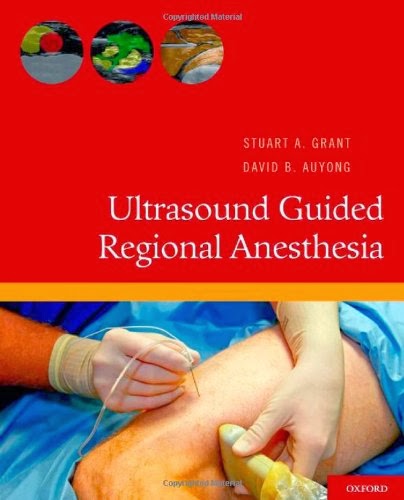
Ultrasound Guided Regional Anesthesia


Stuart A. Grant (Author), David B. Auyong (Author)

Ultrasound technology is enabling anesthesiologists to perform regional anesthetic procedures with greater confidence in accuracy and precision. With improvements in visualizing neural anatomy and needle movement, ultrasound guidance improves patient safety and operating room efficiency. This book offers a detailed, stepwise approach to this technique, identifying pearls and pitfalls to ensure success. Chapters are organized into four sections. The first section provides the basic principles behind ultrasound guided regional anesthesia, setting a strong context for the rest of the book. The last three cover the nerve blocks: upper limb, lower limb, and trunk and spine. Each nerve block is comprehensively explained, divided up by introduction, anatomy, clinical applications, technique, alternate techniques, complications, and pearls. This book provides authoritative, in-depth coverage of ultrasound guided regional anesthesia for the anesthesiologist beginning to use ultrasound and makes a great reference for the more seasoned.

Here